Go 语言基础
go-basics
string
fields&maps
func WordCount(s string) map[string]int {
	cntMap := make(map[string]int)
	strs := strings.Fields(s)
	for _, s := range strs {
		i := cntMap[s]
		cntMap[s] = i + 1
	}

	return cntMap
}- string按空格拆分成列表
strs := strings.Fields(s)- 遍历list
for _, s := range strs {
 // xxx
}- 注意: 自加不能赋值(与Java有区别)
// 如下是非法的.
y := x++
//
x++
y = x
- append
map
package core

import "log"

type NUMANodeMap map[int]string

func iter() {
	nodeMap := NUMANodeMap{
		1: "aa",
		2: "bb",
	}
	// 遍历key
	for n := range nodeMap {
		// n 代表key
		log.Println(n)
		// nodeMap[n] 获取value
		log.Println(nodeMap[n])
	}

	for k, v := range nodeMap {
		// k 代表key
		// v 代表value
		log.Println(k, v)
	}

	// map中增加kv
	nodeMap[3] = "cc"

	// map中移除kv
	delete(nodeMap, 1)
	log.Println(nodeMap)
}
struct
参见: Create, initialize and compare structs · YourBasic Go
简单struct初始化
func TestVertex_Init(t *testing.T) {
	// 单行初始化, 末尾不用 逗号
	v := Vertex{23.2, 22.3}
	log.Println(v)

	// 多行初始化, 末尾需要 逗号
	vertex := Vertex{
		23.2,
		22.3,
	}
	log.Println(vertex)

	// 部分初始化, 需要指定 name, 末尾需要 逗号
	vertex2 := Vertex{
		X: 1.2,
	}
	log.Println(vertex2)

	var vertexP *Vertex
	vertexP = new(Vertex)
	vertexP.X = 1.2

	log.Println(vertexP)
	log.Println(*vertexP)
	assert.Equal(t, *vertexP, vertex2)
	assert.Equal(t, vertexP, &vertex2)
	assert.False(t, vertexP == &vertex2)

	vertexP2 := &Vertex{
		1.2,
		2.2,
	}
	log.Println(vertexP2)

	vertexP3 := &Vertex{
		Y: 1.2,
	}
	log.Println(vertexP3)
}
复杂struct初始化
需要指定内部的struct类型(如下例子中的 Vertext )
func TestTriangle_Init(t *testing.T) {
	v1 := Vertex{1.2, 2.2}

	triangle := Triangle{
		v1,
		Vertex{2, 3},
		Vertex{3, 4},
	}

	log.Println(triangle)
}
struct embedding
如下定义的结构代表啥意思? 为啥第一个 *scheduleroptions.Options 没有filedName呢?
// Options has all the params needed to run a Scheduler
type Options struct {
	*scheduleroptions.Options
	CombinedInsecureServing *CombinedInsecureServingOptions
}
实际上使用了: Go by Example: Struct Embedding 方式, 即类似Java的继承
pointer
方法定义中, Pointer Receiver 与 普通Receiver, 如下 Scale 与 Scale2, 实际上Scale2是没有生效的, 是没有修改原来的值的.
所以
- PointerReceiver: 类似Java类中的普通方法
- 普通Receiver: 类似Java类中的Static方法
type Vertex struct {
	X, Y float64
}

func (v *Vertex) Scale(f float64) {
	v.X = v.X * f
	v.Y = v.Y * f
}

func (v Vertex) Scale2(f float64) {
	v.X = v.X * f
	v.Y = v.Y * f
}
goroutine
如何获取到goroutine的ID?
参见: https://stackoverflow.com/questions/75361134/how-can-i-get-a-goroutines-runtime-id
故意不让我们获取到.
注意: 一个goroutine crash, 会导致整个go进程挂掉. 因此需要保护,
- 保护方式参见: go - How do you keep goroutines running if another one crashes? - Stack Overflow
- 为啥如此设计: Why does Go terminate the whole process if one goroutine paincs? - Technical Discussion - Go Forum 个人理解类似Java的RTE/UncatchedException, 如果不catch, 则会导致进程Crash. 但区别是, Java中通常需要进行catch, Go中有类似的方法recover(), 但Go中不推荐.
go func()
go func() 新建的协程竟然可以直接引用局部变量(而不是通过传参方式). 所以是不是很容易把线程不安全的对象泄露?
func localVar() {
	var myVar = "hello"
	//方式1: 临时创建 匿名方法的 routine
	go func() {
		myVar = "Nice"
	}()
	time.Sleep(1 * time.Second)
	log.Println(myVar)

	//方式2: 直接在方法调用前增加 go 关键词
	go localVar2()
}

func localVar2() {
	log.Println("localVar2")
}
go func/chan sample
在k8s代码中, 看到如下代码, 代表啥意思?
func SetupSignalHandler() <-chan struct{} {
	return SetupSignalContext().Done()
}因此通常的使用方式是:
 ctx, cancel := context.WithCancel(context.Background())
defer cancel()
go func() {
	stopCh := server.SetupSignalHandler()
	<-stopCh
	cancel()
}()
routine tree
context
How To Use Contexts in Go | DigitalOcean
channel
var msgChan = make(chan string)

func sayHello() {
	log.Println("sayHello started")

	go func() {
		msgChan <- "ping"
		log.Println("ping sent")
		msgChan <- "pong"
		log.Println("pong sent")
	}()

	time.Sleep(3 * time.Second)

	msg := <-msgChan
	log.Println(msg)
	msg = <-msgChan
	log.Println(msg)

	log.Println("done")
}
普通channel
var msgChan = make(chan string)普通channel: 只有在收到receive的时候(即receive注册之后), 才会真正send出去. 否则send会一直阻塞.
By default channels are unbuffered, meaning that they will only accept sends (chan <-) if there is a corresponding receive (<- chan) ready to receive the sent value.
即类似Java中的synchronirousQueue, 必须消费者注册/开始消费的时候, 生产者才能执行.
2023/12/05 17:41:29 sayHello started
2023/12/05 17:41:32 ping sent
2023/12/05 17:41:32 ping
2023/12/05 17:41:32 pong sent
2023/12/05 17:41:32 pong
2023/12/05 17:41:32 done
buffered channel
var msgChan = make(chan string, 2)- 运行结果如下, 生产者可以直接放进去, 而不用等消费者注册.
2023/12/05 17:39:34 sayHello started
2023/12/05 17:39:34 ping sent
2023/12/05 17:39:34 pong sent
2023/12/05 17:39:37 ping
2023/12/05 17:39:37 pong
2023/12/05 17:39:37 done- 如果生产者放入的size大于buffer, 则多余部分会一直卡住. 直到buffer中被消费了1个, 则可以放入1个.
channel方向
作为方法参数时, 可以指定channel方向, 这样防止
只写: chan<-
只读: <-chan
// 只写的channel
// 如果改成 (done <-chan bool) 则会编译错误.
func worker(done chan<- bool) {
log.Println("working...")
time.Sleep(time.Second)
log.Println("done...")
done <- true
}panic&recover
如何手动触发panic: panic("test")
mod
go get/go install
go mod download
git上checkout下来的项目, 可以直接使用该命令, 把依赖包都下载下来.
本地如果有多个go mod工程, 如何进行相互依赖?
- 目前看只能使用
replace的方式. 感觉不太方便. - 否则就只能代码push到地址中, 使用
go mod download进行下载. 太不方便. - 为啥不能像maven一样, 可以先安装到本地. 然后其他模块依赖本地的即可.
other
方法名是包级别的. 即一个包下所有的.go文件, 方法不能同名. 而java中是类级别(文件级别)
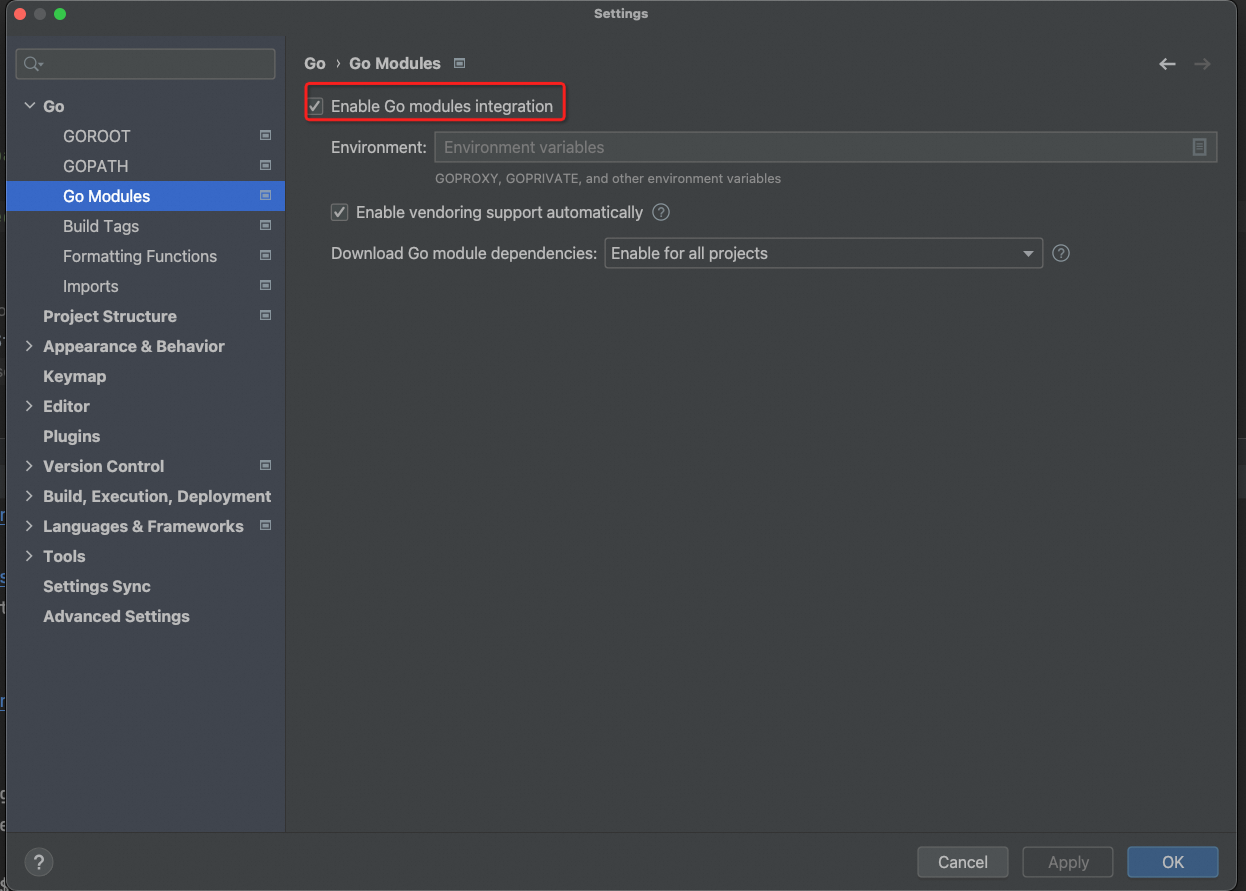
goland不支持go module, 导致依赖无法下载/跳转, 需要手动enable下: